

PicoSure Pro Picosecond Laser
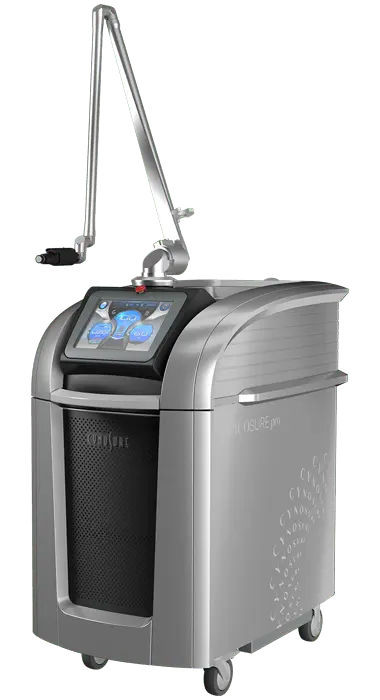
What is PicoSure Pro?
PicoSure Pro is a picosecond laser made by Cynosure. It fires at 755 nm in pulses measured in trillionths of a second, which is fast enough to break pigment apart by a pressure effect rather than by heating it. Less heat in the skin means a lower risk of the burns and pigment changes that older nanosecond lasers could cause.
Dr Garara uses it for the pigment problems patients find most frustrating, from sun spots and freckling to melasma and the marks left behind by old acne. A focusing lens turns the same laser into a skin-revitalisation tool that prompts collagen, so it also softens fine lines, pores and acne scarring.
Because each pulse lasts only picoseconds, energy is delivered faster than the pigment can shed it as heat. The pigment is jolted apart into tiny particles the body then clears, with little warming of the surrounding skin — one of the more forgiving devices to use in richer skin tones.
At a glance
Device type
755 nm picosecond alexandrite laser (with 532 nm capability)
Manufacturer
Cynosure, USA
How it works
Ultra-short picosecond pulses use a photomechanical (pressure) effect
Signature tech
FOCUS diffractive lens array for skin revitalisation
Best known for
Pigmentation, melasma, tattoo removal and acne scars
Pulse duration
Picoseconds (trillionths of a second)
Typical course
Varies by indication; pigment and scars often need a short series
Downtime
Usually minimal; mild redness for a day or so
Skin types
Used across skin types; picosecond pulses lower the heat load
How it works
Photomechanical effect: each picosecond pulse delivers energy faster than pigment can shed it as heat, jolting it into tiny particles the body clears with little warming of surrounding skin.
755 nm wavelength: well absorbed by melanin and common tattoo inks, which is why it suits both unwanted pigment and tattoo removal.
FOCUS lens array: a diffractive lens redistributes energy into high-pressure points beneath the surface, building collagen and elastin without breaking the skin — the setting for fine lines, pores and acne scars.
Comfort and downtime: treatments are quick and most people have only brief redness.
The benefits
Treats pigment with less heat, lowering the risk of heat-related pigment changes.
A genuine option for melasma and post-inflammatory pigmentation that resist other treatments, used carefully.
Removes tattoos: the 755 nm wavelength breaks down a wide range of ink colours.
Softens acne scars and texture via the FOCUS lens.
Quick with little downtime — most sessions are short and leave only brief redness.
Suited to a range of skin tones; the low heat load makes it one of the safer pigment lasers for darker skin.
Concerns it treats
What to expect
Before
Consultation and skin assessment. For tattoo or denser pigment, numbing cream may be used.
During
The handpiece delivers rapid pulses. People describe a snapping sensation and warmth. Sessions are usually short.
Immediately after
Mild redness and sometimes slight swelling; pigment may look darker briefly before clearing.
Downtime
Usually minimal, with redness settling within a day or so.
Results
Pigment clears over the following weeks; skin-revitalisation results build with collagen over a few months.
Course
Single lesions may need one or two sessions; melasma, scars and tattoos need a planned series.
What the evidence shows
Melasma and pigmentation
- A systematic review found that 755 nm picosecond monotherapy improved melasma by 50 to 75 percent in around 40 percent of participants, with the best results when paired with topical tranexamic acid (Pulumati et al., Arch Dermatol Res, 2023).
- In Asian patients with skin type IV, the picosecond 755 nm laser treated melasma and post-inflammatory pigmentation that no longer responded to older lasers, with no hyperpigmentation reported during follow-up (Lee et al., Ann Dermatol, 2017).
Acne scars
- In Chinese patients with skin types III and IV, three sessions of the picosecond alexandrite laser with its lens array improved acne-scar scores by about 28 percent, with high satisfaction and only mild, transient side effects (Zhang et al., Lasers Surg Med, 2019).
Safety in skin of colour
- A review of 56 patients with Fitzpatrick IV to VI treated with the 755 nm picosecond laser and lens array found only transient, self-resolving side effects, supporting its use in darker skin for scars, pigment and striae (Haimovic et al., J Am Acad Dermatol, 2016). Melasma still relapses easily and is treated conservatively, often alongside topical agents.
Individual results vary and depend on assessment at consultation. Manufacturer figures are attributed as such.
Key facts
- PicoSure Pro is a 755 nm picosecond alexandrite laser made by Cynosure.
- Its picosecond pulses clear pigment by a pressure effect rather than heat, lowering the risk of pigment changes.
- It treats pigmentation, melasma, tattoos, acne scars and fine lines, the last via its FOCUS lens.
- A safety review supports its use in Fitzpatrick IV to VI skin.
- Downtime is usually minimal, with treatment given as a short series for pigment, scars and tattoos.
References & sources
- Pulumati A, et al. The role of 755-nm alexandrite picosecond laser in melasma management. Arch Dermatol Res. 2023;316(1):60.
- Lee YJ, et al. Treatment of Melasma and Post-Inflammatory Hyperpigmentation by a Picosecond 755-nm Alexandrite Laser in Asian Patients. Ann Dermatol. 2017;29(6):779-781.
- Zhang M, et al. Safety and Efficacy of a Picosecond Alexandrite Laser With DLA for Acne Scars in Chinese Patients. Lasers Surg Med. 2020;52(2):176-181.
- Haimovic A, et al. Safety of a picosecond laser with diffractive lens array in Fitzpatrick skin types IV to VI: A retrospective review. J Am Acad Dermatol. 2016;74(5):931-936.

Your skin has a story. Learn to read it.
UHai analyses your skin across multiple dimensions — tone, texture, pigmentation, hydration and more — and generates a personalised clinical report in minutes. No appointment needed.
- A clinical skin report, personalised to you
- Analyses tone, texture and pigmentation
- Free to use, no appointment needed
Explore FAQs on PicoSure Pro
Find answers to common questions about PicoSure Pro.
It delivers energy in trillionths of a second, fast enough to break pigment apart by a pressure effect rather than heat. Less heat means a lower risk of burns and pigment changes, particularly in darker skin.
Yes, used carefully. Studies show it can reduce melasma, often best alongside topical agents such as tranexamic acid, though melasma is prone to relapse and is treated conservatively.
Yes. The 755 nm wavelength breaks down a wide range of ink colours into particles the body clears over a course of sessions.
It is one of the more suitable pigment lasers for Fitzpatrick IV to VI because of its low heat load, and a skin-of-colour safety study reported only transient side effects. Settings are still individualised.
It refocuses the laser into pressure points under the skin to build collagen without breaking the surface, which treats fine lines, pores and acne scars.
Usually little. Most people have brief redness, and pigment may darken for a few days before clearing.
Begin with a proper assessment.
Tell us a little about what you're looking for and we'll match you with the right consultation — at the clinic or virtually.